
Do people make custom rims? yes, here is wheel hub modification guide
I. Why Modify Wheel Hubs?
For Appearance Enthusiasts:
Modified wheel hubs are generally more personalized, showcasing the owner’s unique taste while delivering a stronger visual impact and enhanced aesthetics.
For Performance Enthusiasts:
① By increasing the diameter and width of the wheel hub, tire selection naturally becomes wider and lower-profile (flatter). This results in stronger tire grip and a thinner, stiffer sidewall, which reduces deformation during cornering and improves vehicle handling.
② Upgraded wheel hubs are typically made of lighter materials. Reducing unsprung mass contributes to improvements in acceleration, braking, and overall performance.
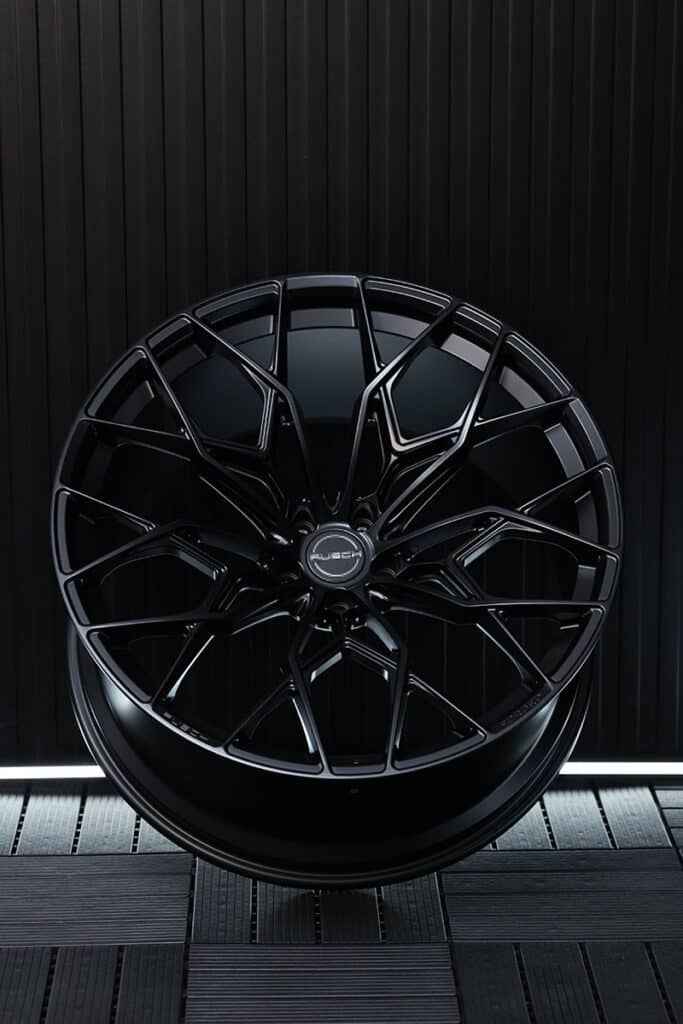
forged wheels matte black (1)
II. How to Choose Modified Wheel Hubs?
1. Hub Specifications
Hub Size: The size of the wheel hub is not “the bigger, the better.” For safety and performance considerations, the selected hub size should preferably not exceed the original wheel hub by more than 2 inches.
Hub Width (J-Value): The “J” refers to the shape of the hub’s flange edge. The J-value is generally used to express the hub width, measured in inches. Hub width is determined by two factors: compatibility with tire width on one hand, and the positional relationship with the fender after installation on the other. It is typically chosen based on the owner’s preference and can be adjusted relative to the original hub width.
PCD (Pitch Circle Diameter): The diameter of the circle formed by the hub’s central mounting bolts. The PCD value must match the original vehicle’s specifications to ensure direct fitment.
CB (Center Bore): This primarily affects the alignment between the geometric center of the vehicle’s hub axis and the geometric center of the wheel hub. Modified wheel hubs generally feature a larger center bore to accommodate a wider range of vehicle models. When the center bore is larger than the hub diameter, a centering ring (spacer ring) can be added to fill the gap.
ET (Offset): This refers to the distance between the hub’s mounting surface and its centerline. The ET value affects the installed position of the wheel hub — determining whether it sits more inward (concave) or outward (flush/convex). Under the same width, a smaller ET value pushes the hub further outward, while a larger ET value pulls it further inward.
2. Hub Materials
Steel, Aluminum Alloy, Magnesium Alloy, Carbon Fiber
Steel Hubs: Low cost and high strength, with strong resistance to metal fatigue and resistance to deformation. However, steel hubs are relatively heavy, have high inertial resistance, and poor heat dissipation. They are also susceptible to rust and corrosion due to environmental factors and wear.
Aluminum Alloy Hubs: Lightweight, excellent heat dissipation, and high strength. However, aluminum alloy hubs have relatively poor elastic properties and demand high manufacturing quality. If manufacturing standards are not met, the hub is prone to fracture upon impact.
Magnesium Alloy Hubs: Even lighter weight with high hardness. However, magnesium alloy hubs are expensive and susceptible to corrosion.
Carbon Fiber Hubs: Lightweight and high in hardness, while also offering corrosion resistance, high-temperature resistance, and metal fatigue resistance. However, carbon fiber hubs are costly to manufacture and maintain.

Carbon Fiber Hubs
3. Hub Manufacturing Processes
Casting, Flow-Form Casting, Forging
Casting: Casting includes both gravity casting and low-pressure casting. The casting process primarily involves pouring molten aluminum alloy into a mold, allowing it to cool, and then finishing it through grinding and machining. This method involves simpler procedures and lower costs, but the material is prone to internal voids and air bubbles, resulting in uneven density that affects overall strength.
Flow-Form Casting (Spun-Forged Casting): This process begins with a rough hub blank produced through low-pressure casting, which is then shaped by a flow-forming machine through rotary pressing, stretching the hub into its final form. After the metal is extruded, the internal molecular structure changes, resulting in increased strength.
Forging: Forging utilizes high pressure to press heated solid alloy into the shape of a wheel hub, followed by secondary machining to produce the finished product. Due to multiple high-pressure impacts, the alloy molecules become smaller, with finer gaps and higher density. Forged hubs offer higher strength and lighter weight, resulting in superior safety performance, as well as greater formability.
Forging is further divided into monoblock forging and CNC-machined forging. Monoblock forging offers high strength, but due to mold limitations, designs tend to be limited in variety. CNC-machined forged billets allow for more flexible design options; however, the machining process alters the grain structure of the forged billet, resulting in strength that is somewhat lower than that of monoblock forged hubs.
4. Hub Styles
One-Piece Hubs: The entire wheel hub is formed as a single unit with fixed specifications.

forged white wheel
Multi-Piece Hubs: The rim (barrel) and spokes are manufactured separately and secured together with bolts. By pairing rims with different specifications, the hub parameters can be adjusted. Multi-piece hubs also feature a more pronounced lip/lip-edge effect, making them generally favored by stance enthusiasts.

bronze wheels forged (5)

 English
 Français
 Deutsch (Sie)
 Español
 Português
 Русский
 العربية
 日本語
 한국어
 Italiano
 Ελληνικά
 Čeština
 Dansk
 Lietuvių kalba
 Hrvatski
 Latviešu valoda
 Polski
 Svenska
 Slovenščina
 Română
 ไทย
 Slovenčina
 Српски језик
 Norsk bokmål
 Македонски јазик
 Nederlands (Formeel)
 Íslenska
 Magyar
 Suomi
 Eesti
 Български
 English (South Africa)
 English (Canada)
 English (Australia)
 English (UK)
 English (New Zealand)
 Deutsch (Schweiz, Du)
 Deutsch (Österreich)
 Español de Chile
 Español de Argentina
 Español de Colombia
 Español de Venezuela
 Español de Costa Rica
 Español de Perú
 Español de Puerto Rico
 Español de México
 Français de Belgique
 Français du Canada
 العربية المغربية
 Português do Brasil
 O‘zbekcha
 Кыргызча
 Қазақ тілі
 Українська
 Bosanski
 Cymraeg
 Aragonés
 Tiếng Việt
 اردو
 ئۇيغۇرچە
 Reo Tahiti
 Татар теле
 Türkçe
 Tagalog
 తెలుగు
 தமிழ்
 Ślōnskŏ gŏdka
 Shqip
 سرائیکی
 සිංහල
 Сахалыы
 Ruáinga
 Português de Angola
 Português (AO90)
 پښتو
 Occitan
 Norsk nynorsk
 Nederlands (België)
 नेपाली
 ဗမာစာ
 Bahasa Melayu
 मराठी
 Монгол
 മലയാളം
 ພາສາລາວ
 كوردی
 ಕನ್ನಡ
 ភាសាខ្មែរ
 Taqbaylit
 ქართული
 Basa Jawa
 Bahasa Indonesia
 Հայերեն
 Hornjoserbšćina
 हिन्दी
 עִבְרִית
 هزاره گی
 ગુજરાતી
 Galego
 Gàidhlig
 Frysk
 Friulian
 (فارسی (افغانستان
 Dolnoserbšćina
 Cebuano
 Català
 བོད་ཡིག
 বাংলা
 Azərbaycan dili
 گؤنئی آذربایجان
 অসমীয়া
 አማርኛ
 Afrikaans